• Skip to primary navigation
  • Skip to main content
  • Skip to footer

Working Partnerships

Grassroots organizing & public policy innovation for a just economy

SIGN UP FOR UPDATES

  • About
    • Our Mission & Vision
    • Our Story
    • Theory of Change
    • People
    • Work with Us
    • Year in Review
  • Work
    • Just Economy
      • Manufacturing Futures
      • Trades Orientation Program
      • Fair Workplace Collaborative
    • Future of Workers
    • Just Cities
      • Working Families Housing
      • A home for every family
      • Accessible transit for all
    • Care for All
    • Vibrant Democracy
      • Redistricting
  • Research
  • News
    • Media Coverage
    • Press Resources
    • Updates
  • Volunteer
  • Donate

Uncategorized

Why we sued the City of San Jose

Today was a big day. Together with the First Amendment Coalition, we filed a lawsuit against the City of San Jose at the Santa Clara County Courthouse. We’re demanding sunlight on the City’s secret backroom negotiations to sell Google some of our most valuable public land.

Since the City of San Jose began discussions with Google about the tech giant bringing 20,000 employees into the city with a huge new mega-campus, we’ve sought details about this project and what it would mean for the city.

San Jose is already in the grip of a severe housing and cost of living crisis. We know from elsewhere in our region that big tech often comes with big increases in homelessness, evictions and rent prices.

We wanted to make sure that the City of San Jose was looking out for its residents in its negotiations with Google. But the more we’ve tried to look into these negotiations, the more the City has tried to block us from finding out the details.

Our mayor and other city staff have signed secretive non-disclosure agreements at Google’s request. They have refused a number of public records requests to release details that should be made public.

That’s why we’ve sued the City today.

Additionally we sent the City a letter outlining the City’s violations of California’s open-meetings law. The City Council has conducted 20+ meetings about the development in secret – behind closed doors with no public accessibility, no transparency and no accountability. We demanded the City bring these debates into the public before taking further action, including the proposed land sale scheduled for December 4th.

Despite all this, the Mayor still wants to rush through the sale of public land before Google has revealed any of the most basic information about the project to the public.

Before this huge decision is taken on the future of the city, we need to bring this whole backroom deal out into the open. We need public meetings. We need the public documents that have been held back. We need to see what plans have been shared with Mayor Liccardo and the City and what if any promises have been made. We need this process re-done in a legal, transparent way so that residents know what’s going on here and can be a part of the debate about the future of their city.

We need to know how this deal will address the public’s biggest concerns: ensuring this project doesn’t lead to more poverty wage jobs, homelessness, rent increases, and evictions.
Back to Graduate Stories
Back to Blog
Back to Reports

Our 2018 ballot guide

How to stand up for affordable housing, good jobs, quality schools and healthcare this election:

The Nov. 6 elections are fast approaching! Our Neighborhood Action Team has been out in the community knocking on doors and speaking to people about the elections and the choices that voters will be making.

There are some crucial initiatives on the ballot that affect our region’s most pressing issues — affordable housing, protections for renters, good jobs with living wages, workers’ rights, school funding, access to healthcare, and funding for vital community services:

State of California

Yes on Prop 1: Affordable housing bond

Prop 1 would ease our housing crisis by allowing the state to build or renovate affordable housing for low-income Californians, veterans, and farmworkers by borrowing $4 billion.

Yes on Prop 2: Housing the homeless bond

Prop 2 would allow the state to build or renovate housing for Californians with mental illness that are homeless.

Yes on Prop 3: Safe water bond

Prop 3 would allow the state to fund water and environmental projects, including upgrading the crumbling water pipelines system that has left some communities in the Central Valley without access to water.

Yes on Prop 4: Children’s hospital bond

Prop 4 would allow the state to construct, expand, renovate, and better equip children’s hospitals by borrowing $1.5 billion.

No on Prop 5: Tax giveaway for wealthy homeowners

Prop 5 would cut over $100 million dollars from the budgets of our local governments and schools every year, growing to about $1 billion annually. Instead, this money would go towards tax breaks for wealthy older homeowners when they decide to purchase a new, expensive home. Losing that funding would seriously impact our schools and communities.

No on Prop 6: Cuts road repair and transportation funding

Prop 6 would cut more than $5 billion in road and public transportation funding. That would stop critical infrastructure projects, including many that are currently underway, like repairing crumbling roads and bridges, filling potholes, and reducing traffic by upgrading our public transit system.

Yes on Prop 8: Safeguards access to dialysis

Prop 8 would help to stop for-profit dialysis clinics from overcharging sick patients and turning patients away if they’re unable to pay.

Yes on Prop 10: Expands right to pass local rent control

Prop 10 will help to stop California families being priced out of their areas and allow people them to remain in their communities and children to stay enrolled in their schools. It would do this by paving the way for stronger rent control protections across the state by allowing cities and counties more control to pass rent stabilization laws that are best for their residents.

No on Prop 11: Eliminates ambulance worker break rules

Prop 11 would remove labor protections for private-sector ambulance workers. That could mean that ambulance workers who already work long, exhausting shifts, do not get uninterrupted breaks while on duty.


Santa Clara County

Yes on Measure A: Continues funding for critical services

Measure A will retain $50 million annually in funding for critical County services by extending a 1/8th of 1 cent sales tax passed by voters in 2012. This funding can be used to fund Valley Medical Center and related health services, programs for the homeless, affordable housing, and other services and programs.


City of San Jose

Yes on Measure S: Public sector contracting reforms

Measure S will give small, local, and economically disadvantaged businesses a better shot at public contracts. It will also allow the city to consider experience and work quality in addition to cost when selecting a contractor for a City project.

Yes on Measure T: Infrastructure funding

Measure T will repair critical infrastructure like bridges vulnerable to earthquakes. It will also repave streets and potholes, and prevent flooding and water quality contamination.

Yes on Measure V: Affordable housing funding

This $450 million bond will assist the city in reaching its goal of adding 10,000 affordable homes over the next five years. The affordable housing funds will be targeted toward extremely low-, low-, and middle-income families who are suffering the effects of the housing crisis the most.

Back to Graduate Stories
Back to Blog
Back to Reports

The Price of Innovation for Silicon Valley’s Workers

If we want tech growth to create widespread prosperity, we need to shift the rules that determine who reaps the benefits.

By Bob Brownstein, Strategic Advisor

Google is planning to build Silicon Valley’s biggest tech campus in downtown San Jose. It’s a project that business leaders have predicted will be a huge economic boon for the Bay Area’s largest city. But will it really benefit most Silicon Valley residents? Twenty years of data give good reason to be skeptical.

Two decades ago — when Google was run out of a garage in Menlo Park — I co-wrote a report finding that the then-nascent tech economy was contributing to instability and insecurity among low-wage workers. This year, we conducted a follow-up study looking at how workers in Silicon Valley have fared in the years since.

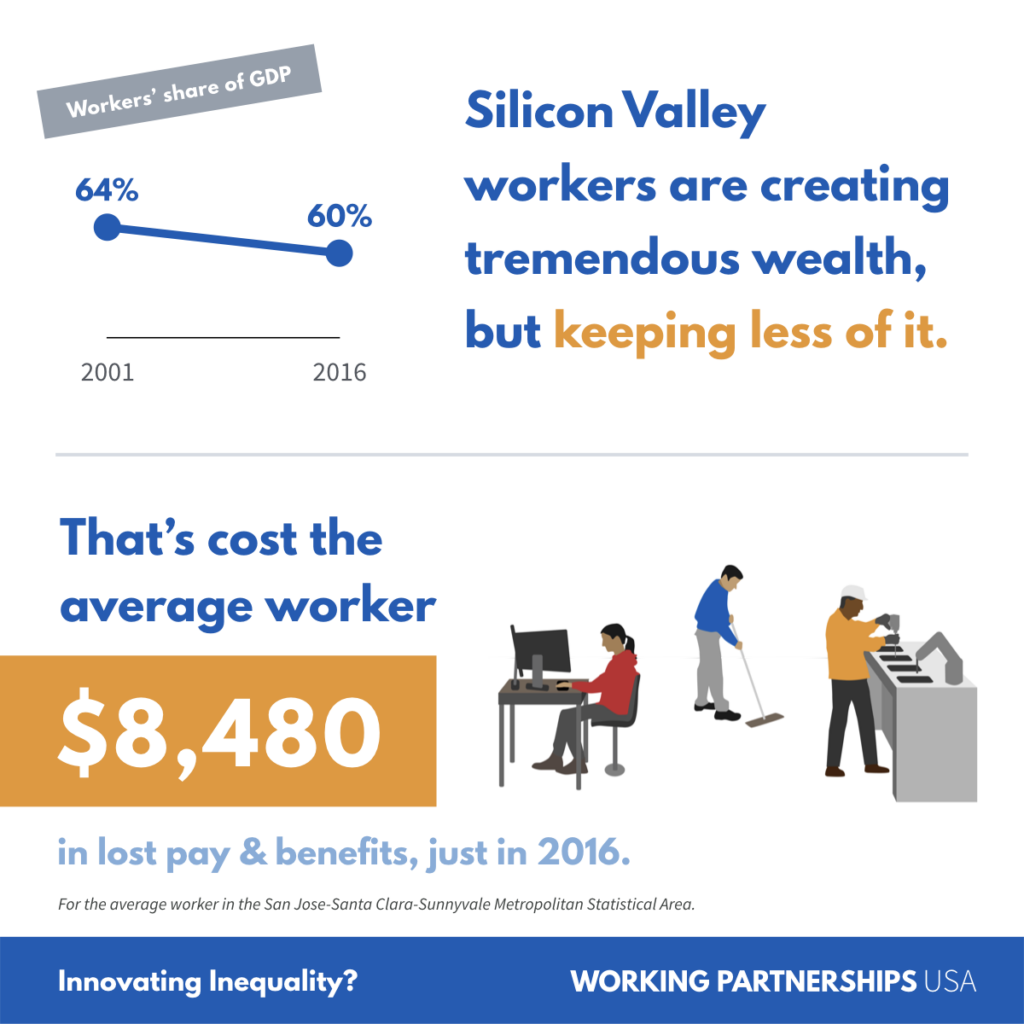
What we discovered was surprising: even though Silicon Valley has recorded the strongest per capita economic growth in the nation, nearly 9 in 10 jobs here pay lower real wages today than they did in 2001. The tech economy is not just failing low-wage workers. It’s now shortchanging nearly all workers.

Why is this happening? We found that the tech industry has adopted business models which let shareholders, executives, and the very upper echelons of tech workers capture an outsized share of the wealth generated by the sector’s growth. For instance, social media platforms or search engines derive a large portion of their profits not from the activities of the company itself, but rather from the network of people posting and searching.

These network effects lead to monopolistic ‘winner-take-all’ markets. An initial slight advantage can result in one or a few firms dominating an entire market, bending the rewards of production towards investors and executives. Those gains have come at the expense of workers and local communities — if workers had kept as much of the wealth they created in 2016 as they did in 2001, each worker would have been paid an extra $8,480 that year alone.

Google exemplifies these trends. Larry Page and Sergei Brin founded Google 20 years ago with technology developed on a National Science Foundation-funded research project. Since then, it has grown into an $800 billion company that accounts for 90 percent of internet searches.

Yet as it has grown, the tech giant has shifted towards hiring more contract workers instead of full-time employees. Contractors often have lower wages, fewer benefits and more job insecurity. Bloomberg reports that contractors now make up the majority of Google’s global workforce.

Meanwhile, Google has driven up the cost of living near its Mountain View headquarters, pricing more and more residents out of their homes. RVs line Mountain View’s streets and many workers face longer commutes after being forced to move further away.

This happens over and over again in Silicon Valley. A small number of firms end up dominating entire markets, funneling enormous rewards towards investors and away from everyone else.

If we want tech growth to create widespread prosperity, we need to shift the rules that determine who benefits from innovation. The data we’ve studied tells us that simply bringing a big tech company into town does not create prosperity. But there are ways we can make sure that communities get a share of the wealth.

For Google’s proposed mega-campus, that could start with a community benefits package. In exchange for selling the tech giant some of San Jose’s most valuable public land, grassroots groups — including the Silicon Valley Rising coalition that we’re part of — have called on Google to negotiate a community benefits agreement to invest in affordable housing, prevent displacement, ensure family supporting jobs for construction and service workers, and address other needs while giving the community a role in enforcement.

Such an agreement would be a promising step towards compensating the public for their contributions and ensuring that Google’s growth benefits not just wealthy investors, but also the broader public.

Addressing economic inequality and financial insecurity brought by the growth of the tech sector will take a range of solutions, but steps like a community benefits agreement can put us on the right trajectory. If the next wave of innovation is going to bring advances — not just in technology, but in the lives of working families — then people need to be equal partners in shaping how tech grows in our communities.

Bob Brownstein is the Strategic Advisor at Working Partnerships USA and a co-author of the new report, “Innovating Inequality: How tech’s business models concentrate wealth while shortchanging workers.”

Originally published on Inequality.org

Back to Graduate Stories
Back to Blog
Back to Reports

Seven ways to support the Marriott workers on strike

Workers at the Marriott Hotel in San Jose are striking for a living wage and a fair contract. Here are seven ways you can support the workers in their fight:

  1. HONK: If you drive by the picket line on South Market Street (map), tap on your horn. A friendly beep shows support and encourages workers.
  2. SIGN THE PETITION: Add your name to the One Job Should be Enough Pledge
  3. DONATE: This GoFundMe supports workers during this time.
  4. PACK GROCERIES: WPUSA is continuing to organize grocery deliveries in partnership with Sacred Heart Community Service. Email priscilla@wpusa.org to help assemble, unload, and load groceries between 12-1:30pm and/or 1:30-2:30pm in downtown San Jose this coming Tuesday, October 23, or to express interest for a later date — especially if you have a truck or van!
  5. WALK: Walk with workers, who are on the picket line 24/7. Show up to the San Jose Marriott (301 S Market St) and simply join the march. Please contact us if you are new to this and would like additional support.
  6. SOCIAL MEDIA: Follow Unite Here Local 19 on social media for the latest updates (Facebook | Twitter), and help amplify content by sharing tweets and Facebook live streams. Create your own posts using hashtags #1job #MarriottStrike; share informational links like this on your favorite platform.
  7. DO NOT CROSS PICKET LINES: Crossing a picket line directly undermines the struggle of striking workers. Refuse to patronize Marriott hotels as well as any other business being picketed.

Back to Graduate Stories
Back to Blog
Back to Reports

Why Silicon Valley is getting poorer

Silicon Valley’s economy is booming. Yet nearly 9 in 10 jobs here pay lower wages today than they did 20 years ago.

Why? Our new study, Innovating Inequality?, finds that the tech industry has developed business models that concentrate wealth by systemically shortchanging workers and communities.

Released in partnership with UC Santa Cruz Professor Chris Benner and the UCSC Everett Program, the study finds that Silicon Valley’s workers have produced the fastest per capita economic growth in the nation, but those huge profits overwhelmingly end up in the hands of a small group of investors and CEOs.

Across the country, cities are bending over backwards to emulate Silicon Valley. But big tech doesn’t mean widespread prosperity — unless workers and communities have the power to ensure that everyone who contributes to tech shares in its success. It’s time to rewrite the rules so workers and communities get a fair return on their work.

Back to Graduate Stories
Back to Blog
Back to Reports

Measure V: $450 million for affordable housing

A place to call home is an essential ingredient to one’s self worth and personal dignity. But unfortunately too many Silicon Valley families are priced out of a roof over their heads.

San Jose’s Measure V takes an important step toward raising the funds to address this growing problem.

That’s why we think San Jose voters should back Measure V in November’s election.

This $450 million bond will assist the city in reaching its goal of adding 10,000 affordable homes over the next five years. If passed by a two-thirds majority of voters in November, the affordable housing funds will be targeted toward extremely low-, low-, and middle-income families.

For this reason, we recommend a YES vote for Measure V on November 6 – and will continue to educate our organized base of over 60,000 voters to support affordable housing production and good jobs with strong worker protections against exploitation, especially among vulnerable immigrant workers.

Back to Graduate Stories
Back to Blog
Back to Reports

  • « Go to Previous Page
  • Page 1
  • Interim pages omitted …
  • Page 5
  • Page 6
  • Page 7
  • Page 8
  • Page 9
  • Interim pages omitted …
  • Page 15
  • Go to Next Page »

Footer

workingpartnershipsusa

Silicon Valley is known for technology, investment Silicon Valley is known for technology, investment, and big ideas, but innovation begins with people.⁠
⁠
Today, we're joining the the Immigrant Protection & Empowerment Network (IPEN) in launching People Power Innovation, a campaign to recognize and support the immigrants who make Silicon Valley possible - from those who build the next tech innovations to the janitors, security guards,  and cafeteria workers who are the critical backbone that keeps the tech industry running. ⁠
⁠
The campaign calls on tech workers, companies, leaders, and residents to stand with immigrant communities and help protect the people behind the region’s success.⁠
⁠
Swipe to learn about the campaign and how you can participate. ➡️⁠
Follow @PeoplePowerInnovation, share this post, and invite others to join us. ⁠
⁠
#PeoplePowerInnovation #ImmigrantsPowerSiliconValley⁠
Everyone in Santa Clara County deserves a stable p Everyone in Santa Clara County deserves a stable place to call home. 🏡🏢

Working Families Housing is a new blueprint to build permanently affordable homes twice as fast—pairing smart public policy with mission-driven investment, and creating good union jobs along the way.

These recommendations draw from the insights of 70+ union leaders, policy experts, developers, and community members who believe housing stability shouldn't be out of reach for the people who keep our county running.

This work would not be possible without our co-chairs: @scbtc, @workingpartnershipsusa, @sobaylabor, @supbettyduong, @mtnviewellen, @supervisorabekoga, @peterortizd5, @larrykleinsunnyvale, and @svathome.

And we're just getting started—now, we build.

#WorkingFamiliesHousing #SantaClaraCounty #AffordableHousing #HousingJustice
When our neighbors needed them, they answered 💪⁠ ⁠ When our neighbors needed them, they answered 💪⁠
⁠
This year, we're honoring the first group people call when ICE activity in our region threatens the safety of a family member or worker in our County—the Santa Clara County Rapid Response Network.⁠
⁠
Since 2016, @scc_rapidresponsenetwork has grown from a handful of volunteers to over 3,000 strong, running a 24/7 hotline that dispatches trained legal observers to verify and document ICE activity in real time. ⁠
⁠
They organize and empower the community—running know-your-rights education across all 15 cities in Santa Clara County and standing publicly with immigrant families so no one is pushed into the shadows. Every day, they demonstrate people power that doesn't ask the government for permission. ⁠
⁠
Join us at Champions For Change 2026 on Sep 17 as we celebrate the SCC Rapid Response Network as one of this year's Champions.🏆⁠
⁠
🎟️ Get your tickets today at the link in our bio!
This year, we're honoring a leader who's spent 30 This year, we're honoring a leader who's spent 30 years protecting working people in California and across the country—David Huerta.⁠
⁠
As President of SEIU-United Service Workers West, David's spent his career (since joining SEIU in 1996) defending immigrant workers and working families, often before it was safe or easy to do so.⁠
⁠
He and SEIU-USWW have long been partners of ours here in Santa Clara County—standing together to make sure the thousands of workers who power the tech industry have dignity and a voice on the job.⁠ David reminds us that courage means acting before it's safe, before it's easy, and finding joy and power in doing it together. ⁠
⁠
Join us at Champions For Change 2026 on Sep 17 as we celebrate David as one of this year's Champions. 🏆⁠
⁠
🎟️ Get your tickets today at the link in our bio!
460,000 people in Santa Clara County rely on Medi- 460,000 people in Santa Clara County rely on Medi-Cal. A new rule could 129,000 of them at risk of losing their coverage by 2028. 

25 states are suing to stop it. 

Tell us how this new rule would effect you or your loved ones using the link in our bio!
AI feels like it's everywhere right now. Let's tal AI feels like it's everywhere right now. Let's talk about it!

Join us for a conversation with Alex Hanna, leading researcher and thinker in AI and tech!

We'll dig into the real challenges you're facing with AI, hear from Alex about her work, and have an open conversation about where we go from here. 
This is an opportunity to find shared values, common goals, and ways we can act together. 

RSVP at the link in our bio! 🔗 

 #AI #TechTalk
When Savannah learned the program was free, it cha When Savannah learned the program was free, it changed everything.⁠
⁠
TOP is a no-cost apprenticeship-readiness program that prepares individuals for careers in the trades—combining classroom instruction, hands-on training, and direct pathways to union opportunities.⁠
⁠
For many, it’s the first step toward a stable, long-term career.⁠
⁠
wpusa.org/top⁠
⁠
#StartWithTOP
Every county needs somewhere that can't say no. Fo Every county needs somewhere that can't say no. For Santa Clara County, that's VMC.

When a private ER hits capacity, patients get redirected. When VMC hits capacity, there's nowhere left to go. Cutting this system doesn't just hurt VMC's patients. It raises the risk for everyone who needs an ER bed in this county.

This is the hospital holding the whole system together. #HandsOffOurHealthcare. Protect Santa Clara Valley Healthcare.
Today for #ParamedicAppreciationDay, We're highli Today for #ParamedicAppreciationDay,

We're highlighting our public healthcare system that ensures anyone can get care when they need it: the Santa Clara County hospital system doesn't ask what insurance you have—it just treats you.

But this model is under direct attack. H.R. 1 is gutting the Medi-Cal funding it runs on, and we're still $270 million short this year—not from mismanagement, but because Washington pulled the floor out.

Swipe to see what's at stake.

#HandsOffOurHealthcare

Protect Santa Clara Valley Healthcare.
An airport can't run without its workers. ✈️ Yest An airport can't run without its workers. ✈️

Yesterday, we joined airport workers at San José Mineta International Airport to stand with them in their fight for a fair contract. Every worker deserves dignity on the job, fair wages, and working conditions that respect the essential role they play in keeping our communities connected.

When workers stand together, they build the power to win not just for themselves, but for all working people. ✊🏽
The people who keep our communities running deserv The people who keep our communities running deserve to be heard! 🔊⁠
⁠
Last Friday, workers from healthcare, childcare, fast food, gig work, and other industries came together with elected officials and candidates to share their experiences directly. From unsafe working conditions and low wages to the rising cost of living, workers spoke honestly about the challenges they face every day—and the changes they need to see from the people making decisions that affect their lives.⁠
⁠
Real solutions start by listening to the people closest to the issues.
🐱 Things are getting purr-ty hot out there.⁠ ⁠ Whe 🐱 Things are getting purr-ty hot out there.⁠
⁠
When indoor temperatures reach 82°F, employers in Santa Clara County must provide important heat protections, including cool drinking water, a cool-down area, and training on heat illness. Staying safe at work isn't a perk—it's your right.⁠
⁠
Know your rights, share this with your coworkers, and visit the link in our bio for more workplace resources. 😸⁠
Follow on Instagram

WORKING PARTNERSHIPS USA
2302 Zanker Road, San Jose, CA 95131
P: (408) 809-2120 | F: (408) 269-0183
MEDIA CONTACTS | PRIVACY POLICY

Copyright © 2026 Working Partnerships USA